Nuclear Medicine Dose Calculator
Dosage calculator for radiopharmaceutical preparation. Models isotope decay to compute the required volume for a target activity at a chosen administration time.
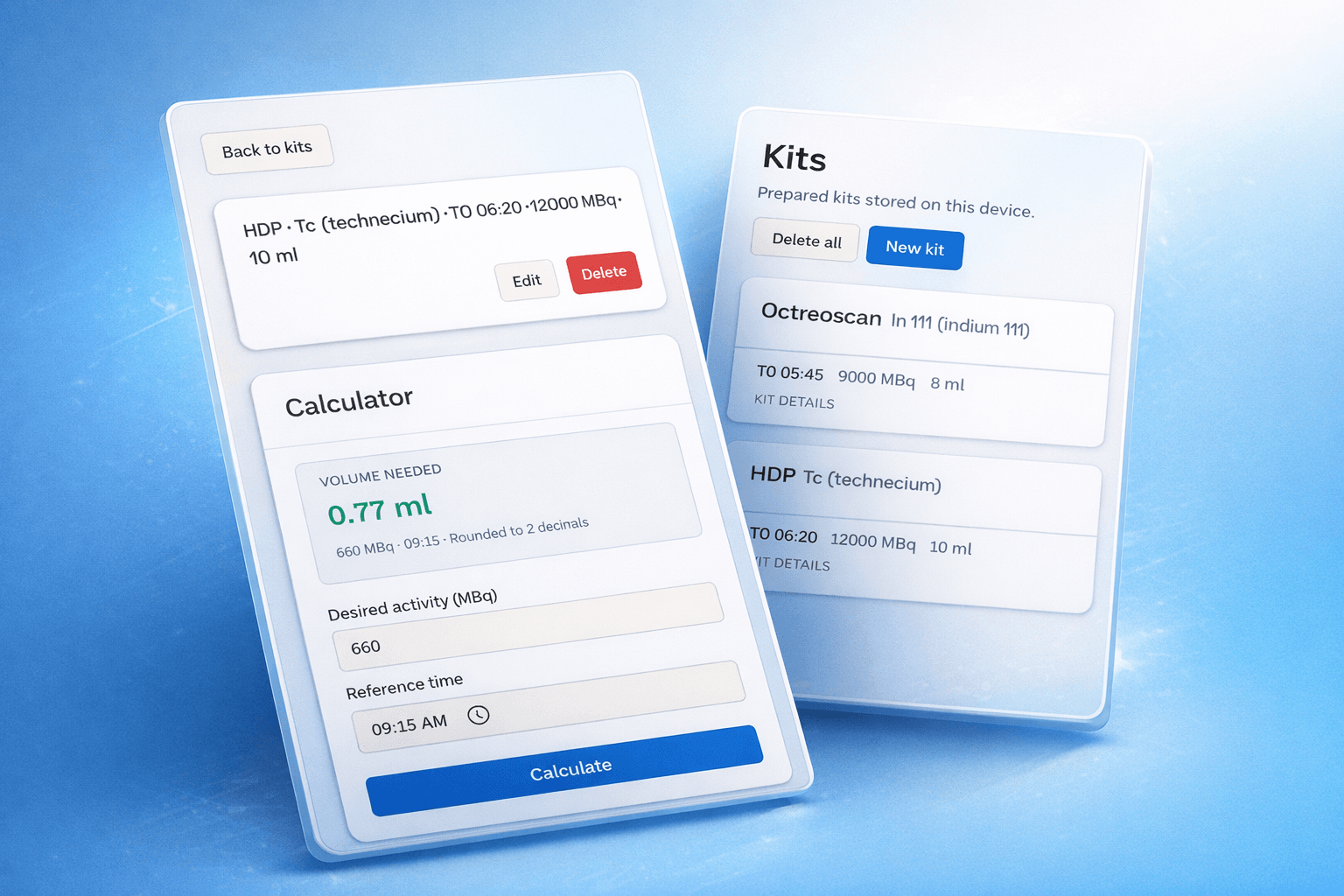
Introduction
A lightweight calculator designed for nuclear medicine staff preparing SPECT radiopharmaceutical doses. It streamlines decay-based volume calculations, supports multiple kits, and reduces time spent handling radioactive material. By minimizing trial-and-error, it lowers staff radiation exposure and improves workflow efficiency.
Background
This was the first tool I built. While working as clinical staff, I prepared radiopharmaceuticals daily. I wanted to automate repetitive tasks to reduce errors and save time. Hospital policies prohibited installing software on workstations, so I created a PowerShell script that complied with the rules and solved the problem. It wasn’t perfect, but it worked—and more importantly, it sparked my passion for engineering.
Later, after learning web development, I rebuilt the concept as a browser-based tool with a user-friendly interface and portability.
Problem
SPECT radiopharmaceutical kits are prepared in batches that decay continuously. Each patient requires a target activity at the time of administration, often hours after calibration. This creates a recurring challenge:
- The same volume drawn at different times yields different activity.
- Correct volume depends on isotope half-life and elapsed time.
- Manual calculations or spreadsheets increase the risk of mistakes and delays.
Errors prolong handling, which directly increases staff radiation exposure. The goal was to achieve correct dosing on the first attempt and reduce time spent on math during preparation.
Solution
A calculator that computes the volume to draw to reach a target activity at a chosen time:
- Select isotope (mapped internally to a fixed half-life table).
- Enter kit calibration values: total activity, total volume, and calibration time.
- Enter target activity and administration time (defaults to “now,” but can be scheduled).
- Get the required volume instantly.
The tool supports multiple kits per day, so each batch can be saved and reused for subsequent doses.
Compliance note: The calculated volume does not replace measurement. Staff must still measure syringe activity and produce the legally required label. The tool’s value is speed and first-pass accuracy.
How it Works
- Create a kit: choose isotope, enter calibration time, total activity, and total volume.
- Pick administration time: default is current time, but can be set later.
- Enter target activity: input the required MBq for the patient.
- Read volume result: the app outputs the volume to withdraw.
- Verify and label: measure syringe activity and produce documentation.
- Repeat quickly: reuse saved kits for additional doses.
- Manage multiple kits: switch between several kits prepared the same day.
Scope of Isotope Support
Focused on SPECT workflows: common tracers such as Tc-99m and I-123, plus legacy tracers like Ga-67 and indium-based tracers. PET isotopes were feasible to add but not required in the target department.
Architecture
- Isotope selection maps to decay parameters via a fixed half-life table.
- Core computation applies radioactive decay over elapsed time and scales volume proportionally.
- Kits are stored as structured entries for repeat calculations.
Key Engineering Choices
- Zero friction inputs: users only enter values they already record.
- Constraint-driven delivery: started as PowerShell for “no installs,” later evolved into a browser-first tool.
- Workflow first UI: optimized for quick, repeated calculations.
- Time-aware calculation: administration time is explicit and editable.
- Pragmatic role: complements mandatory measurement and labeling instead of replacing them.
Results
- Reduced manual calculation overhead during dose preparation.
- Improved first-pass accuracy when selecting volumes for target activities.
- Minimized recalculation attempts, saving minutes per dose and reducing unnecessary exposure.
- Provided a lightweight alternative for departments without advanced calibration hardware.
Implementation Notes
- Early version: prompt-driven PowerShell script with per-tracer instances.
- Later version: browser UI designed for mobile/tablet use near the preparation area, supporting multiple kits and fast repeat calculations.